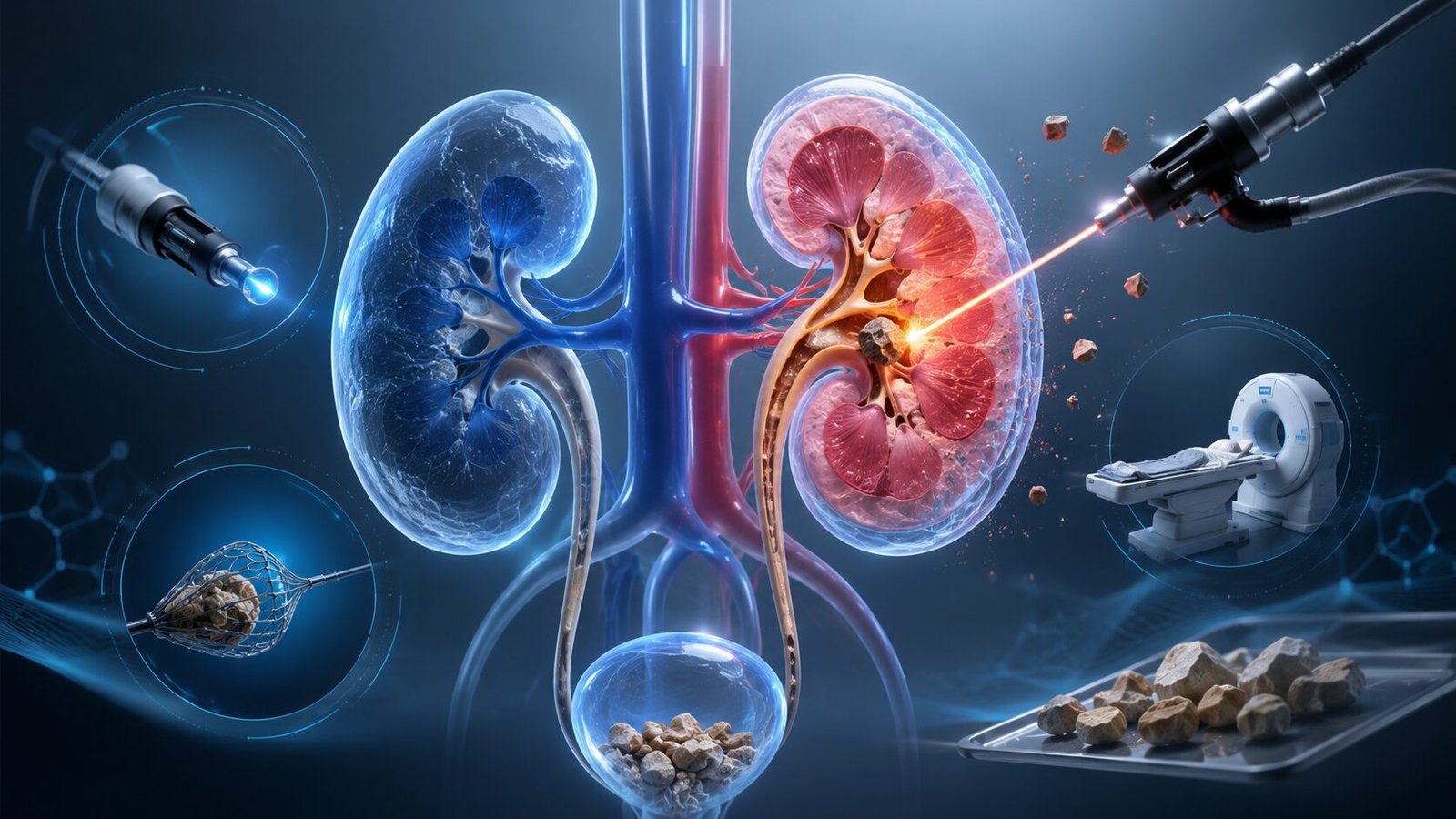
A kidney stone diagnosis does not automatically mean surgery. Many small stones can pass naturally with pain relief, medical supervision and, in selected cases, medicines that help relax the urinary passage.
However, a larger stone, urinary blockage, infection or continuing pain may require active kidney stones treatment such as shock-wave therapy, ureteroscopy, laser treatment or PCNL surgery.
The right option depends on the stone’s size, location, hardness, symptoms and effect on kidney function.
Can Kidney Stones Be Treated With Medicines?
Can medicines dissolve or remove every kidney stone?
No. Most medicines do not directly dissolve common calcium-based kidney stones.
For a small stone in the ureter, a doctor may recommend:
- pain-relieving medicines;
- medicines that relax the ureter and may help the stone pass;
- adequate fluids, depending on the patient’s condition;
- follow-up imaging to check whether the stone is moving.
Small ureteric stones may pass without surgery, but the likelihood decreases as stone size increases. Alpha-blocker medicines may be considered for certain distal ureteric stones larger than 5 mm. They should only be taken after medical evaluation.
Drinking large quantities of water during an active pain episode does not force a blocked stone out. Hydration is useful for prevention and avoiding dehydration, but it is not a substitute for proper imaging and treatment.
When Is Surgery for Kidney Stones Needed?
A doctor for kidney stones may recommend active removal when the stone:
- causes repeated or uncontrolled pain;
- blocks urine flow;
- is associated with infection;
- continues to grow;
- causes blood in the urine or kidney swelling;
- is unlikely to pass naturally;
- affects kidney function.
Kidney stones associated with fever, chills or difficulty passing urine require urgent medical attention. An infected, obstructed kidney can become a medical emergency. Guidelines recommend active treatment when stones cause growth, obstruction, infection or significant symptoms.
What Is Laser Surgery for Kidney Stones?
The phrase laser surgery for kidney stones usually refers to ureteroscopy with laser lithotripsy. During ureteroscopy, a thin instrument is passed through the natural urinary passage. The surgeon locates the stone and uses laser energy to break it into smaller fragments. Some pieces may be removed, while smaller fragments may pass naturally afterward.
There is usually no external cut. A temporary ureteric stent may be placed to maintain urine flow and support healing. Ureteroscopy generally offers a better chance of becoming stone-free in a single procedure than shock-wave lithotripsy, although it is more invasive and may have a higher complication rate.
When may ureteroscopy be advised?
It may be considered for:
- stones in the ureter;
- stones that have not passed with observation;
- stones unsuitable for shock-wave treatment;
- kidney stones that can be reached with a flexible scope;
- patients needing a higher chance of clearance in one procedure.
What Is PCNL Surgery?
PCNL, or percutaneous nephrolithotomy, is a minimally invasive operation generally used for large or complex kidney stones. The surgeon creates a small passage through the back into the kidney. A specialised instrument is then used to break and remove the stone directly.
When is PCNL commonly recommended?
PCNL surgery is generally the first-line procedure for kidney stones larger than 2 cm. It may also be recommended for staghorn stones, multiple large stones or stones unlikely to clear adequately through less invasive procedures.
Compared with ureteroscopy or shock-wave treatment, PCNL usually provides better clearance for large stone burdens, but it involves a hospital stay and a longer recovery period.
ESWL, Ureteroscopy or PCNL – Which One Is Better?
There is no single procedure that is best for every patient.
| Treatment | Commonly considered for | Key point |
| Medicines and observation | Selected small ureteric stones | Avoids a procedure but requires follow-up |
| ESWL | Selected kidney or upper ureter stones, often below 2 cm | Non-invasive, but repeat sessions may be needed |
| Ureteroscopy with laser | Ureteric and selected kidney stones | Higher chance of clearance in one procedure |
| PCNL | Large stones, usually above 2 cm, or complex stones | Highest clearance potential for large stone burden |
Shock-wave treatment, ureteroscopy and PCNL are all established options. As stones become larger, shock-wave treatment and ureteroscopy may become less effective, while PCNL effectiveness is less affected by stone size.
The final decision should be based on CT or ultrasound findings rather than stone size alone.
Kidney Stone Myths and Facts
Every kidney stone requires an operation
Fact: Many small stones can pass with observation, pain management and appropriate medical treatment.
Drinking beer flushes out kidney stones
Fact: Alcohol can contribute to dehydration and is not a kidney stone treatment.
Laser surgery involves a large incision
Fact: Laser ureteroscopy is usually performed through the natural urinary passage without an external surgical cut.
Pain stopping means the stone has passed
Fact: Pain may reduce even when the stone remains lodged. Follow-up imaging may still be necessary.
PCNL is open surgery
Fact: PCNL uses a small access tract through the back and is different from traditional open kidney surgery.
When Should You Find a Stone Hospital Near You?
Seek urgent care when kidney-stone symptoms occur with:
- fever or chills;
- inability to pass urine;
- severe pain that does not settle;
- repeated vomiting;
- weakness, confusion or dehydration;
- pregnancy, a single functioning kidney or known kidney disease.
When searching for a stone hospital near me, look for a hospital with urology consultation, imaging, emergency support and access to multiple treatment options. A centre offering ureteroscopy, laser lithotripsy and PCNL can select treatment according to the stone rather than forcing every patient into the same procedure.
Frequently Asked Questions
Can a 5 mm kidney stone pass naturally?
Many stones around this size can pass, particularly when located in the ureter. However, location, swelling, symptoms and individual anatomy also influence the outcome.
At what stone size is surgery required?
There is no universal cut-off. Stones above 10 mm are less likely to pass naturally, while kidney stones above 2 cm are generally treated with PCNL. Symptoms and obstruction can make treatment necessary even for a smaller stone.
Is ureteroscopy painful?
The procedure is performed under anaesthesia. Some patients experience burning during urination, urinary frequency or discomfort from a temporary stent afterward.
Is laser kidney stone surgery safe?
It is a commonly used, minimally invasive treatment. Possible risks include infection, bleeding, ureteric injury and temporary stent discomfort. The surgeon should explain individual risks before treatment.
How long does recovery take?
Many patients undergoing ureteroscopy return to routine activities within several days, depending on their condition and stent-related symptoms. Recovery after PCNL is generally longer.
Can kidney stones return after surgery?
Yes. Surgery removes the existing stone but does not always remove the underlying tendency to form stones. Hydration, dietary advice, stone analysis and metabolic testing may help reduce recurrence.
Choosing the Right Kidney Stone Treatment
Kidney-stone treatment should not be selected from symptoms or an online size chart alone. Imaging is needed to determine the stone’s location, size and effect on urine drainage.
A urologist can then decide whether observation, medication, ESWL, ureteroscopy, laser surgery for kidney stones or PCNL surgery is most appropriate.
Kidney Stone Care at Nulife Hospitals
At Nulife Hospitals, the Urology Department evaluates kidney stones, severe stone pain, urinary blockage, recurrent stones, blood in the urine and other urinary concerns.
If you have persistent pain, repeated urinary symptoms, vomiting, fever, difficulty passing urine or a diagnosed kidney stone, a urology consultation can help determine whether medicines, ureteroscopy, laser treatment or PCNL may be appropriate.
Book an appointment with Nulife Urology Department for kidney stone evaluation, laser surgery for kidney stones, ureteroscopy, PCNL surgery and urology care in Delhi.
Medical Disclaimer: This article is for patient education only and should not replace consultation with a qualified doctor. Do not start, stop or change medicines for kidney stones without medical advice. Treatment depends on the stone’s size, location, composition, symptoms, urinary obstruction, infection risk, kidney function, age, medical history and other health factors.
Medically reviewed by: Department of Urology, Nulife Hospitals
Last updated: July 2026