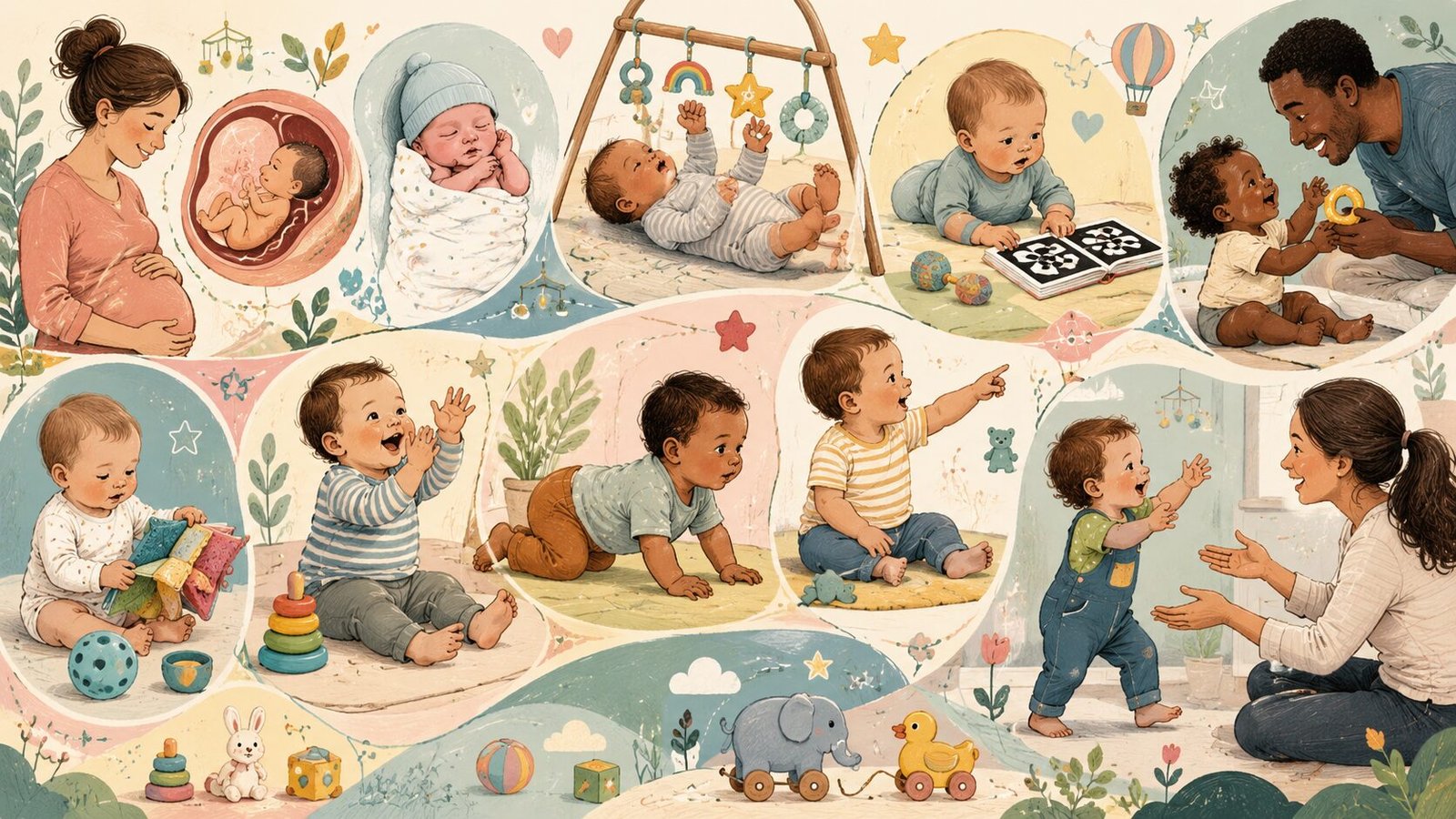
Watching a baby smile, sit independently, say a first word or take a few unsteady steps can be exciting for the entire family. These changes are commonly called baby developmental milestones.
Developmental milestones are skills that children generally acquire as they grow. They include how a baby moves, communicates, learns, plays and interacts with other people. However, these milestones should be treated as helpful developmental markers—not as strict deadlines that every baby must meet on exactly the same day or month.
Every child develops at an individual pace. Some babies may begin walking early but speak later, while others may develop language quickly and take more time to gain physical confidence. Regular developmental monitoring helps parents and paediatricians understand a child’s overall progress rather than focusing on one isolated skill.
What Are Baby Developmental Milestones?
Baby developmental milestones are abilities that most children can perform by a particular stage of development. They offer useful clues about how a child’s brain, body and social abilities are developing.
Development is usually observed across four connected areas:
- Physical movement and motor skills,
- Language and communication,
- Learning and problem-solving,
- Social and emotional interaction.
A baby may progress differently in each area. For example, crawling and walking are physical milestones, while responding to familiar voices, babbling, pointing and playing simple games reflect communication, learning and social development.
The first two years are especially important because a baby’s brain develops rapidly during this period. Nutrition, health, responsive caregiving, play and regular interaction all contribute to early childhood development. UNICEF India describes the first 1,000 days, from pregnancy to approximately two years, as an important period for growth and development. Parents can read more through UNICEF India’s early childhood development guidance.
Baby Developmental Milestones from Birth to 6 Months
During the first few months, babies gradually become more alert and responsive to the world around them.
Early social and communication development
A young baby may begin looking at faces, responding to familiar voices and smiling during interaction. As the months progress, crying is joined by cooing, laughing and other sounds.
Parents may notice that the baby becomes increasingly interested in people, tracks movement with the eyes and reacts when spoken to or comforted.
Early physical development
In the beginning, a baby needs complete head and body support. Gradually, neck strength improves, and the baby may begin lifting the head during supervised tummy time.
By the later part of this stage, many babies start reaching for toys, bringing their hands to their mouth and rolling from one position to another. Movement may initially look uncoordinated, but control generally improves with practice.
Rather than repeatedly testing the baby, parents can encourage development through face-to-face interaction, supervised floor play, songs and age-appropriate toys.
Baby Milestones from 6 to 12 Months
The second half of the first year often brings more visible changes in movement, communication and curiosity.
Sitting, crawling and exploring
Many babies develop enough balance to sit with less support and eventually sit independently. They may begin moving across the floor by rolling, shuffling or crawling.
Not every baby follows the same movement sequence. Some babies crawl on their hands and knees, while others move differently or progress directly towards pulling themselves up.
As mobility increases, childproofing becomes essential. Medicines, electrical sockets, stairs, sharp furniture edges and small objects should be kept safely out of reach.
Babbling and understanding language
Babies often begin repeating sounds such as “ba,” “ma” or “da.” These sounds may initially be playful rather than meaningful.
They may also respond to their name, recognise familiar people, understand simple words and use gestures such as reaching or raising their arms to be picked up.
Talking to the baby during feeding, bathing and play can support communication. Parents do not need special teaching tools; ordinary conversation, songs, facial expressions and shared play are highly valuable forms of stimulation. Responsive interaction and care are central to healthy early development.
Developmental Milestones from 12 to 18 Months
Between the first birthday and 18 months, many children become more active and independent.
Standing and early walking
A child may pull to stand, move while holding furniture and eventually take independent steps. Falls and unsteady movement are common while balance is developing.
Walking should not be treated as a competition. Comparisons with siblings, cousins or children of the same age can create unnecessary anxiety because the normal developmental range can be broad.
First words and gestures
Some children begin using a few meaningful words during this period. They may also point to request something, wave, imitate sounds and follow simple instructions supported by gestures.
Communication includes more than spoken words. Eye contact, pointing, imitation, facial expressions and the ability to share attention with a caregiver are also important parts of early language and social development.
Learning through imitation
Toddlers often copy everyday actions such as using a spoon, brushing hair or pretending to speak on a phone. This imitation reflects growing memory, observation and problem-solving.
Simple household play, picture books, stacking toys and supervised exploration can be more useful than complicated or expensive learning products.
Developmental Milestones from 18 to 24 Months
By the second year, toddlers usually become increasingly expressive, mobile and curious.
Movement and coordination
Many toddlers can walk with greater confidence, begin running, climb onto low furniture and attempt to kick or throw a ball.
Fine motor skills also improve. A child may turn book pages, stack a few blocks, use a spoon with some spilling or scribble using a crayon under supervision.
Language and understanding
Language development varies considerably at this age. Some children use several words, while others begin combining words later.
Parents should observe not only the number of words but also whether the child understands familiar instructions, communicates needs through gestures or sounds, points to interesting objects and attempts to interact.
Social and emotional development
Toddlers may show affection, seek reassurance from familiar adults and become more aware of other children. They may play beside other toddlers without fully playing together.
Tantrums can also become more common. At this age, children often understand more than they can express, which can lead to frustration.
How Parents Can Support Baby Developmental Milestones?
Supporting development does not require turning the home into a classroom. Babies learn through safe, repeated and responsive interaction.
Talk to your baby throughout the day, even before they can reply. Read picture books, sing simple songs and respond when the baby makes sounds or gestures. Provide supervised floor time so the child can practise movement freely.
Allow toddlers to explore safe objects, attempt small tasks and play at their own pace. Avoid pressuring them to perform for visitors or repeatedly comparing them with other children.
Nutrition, sleep, emotional security and regular health check-ups also influence development. UNICEF’s early childhood framework emphasises health, nutrition, safety, responsive care and opportunities for early learning as interconnected parts of nurturing care.
When Should Parents Discuss Development with a Pediatrician?
Parents should speak with a pediatrician whenever they have a persistent concern, even when they are unsure whether it is significant.
Consultation is particularly important when a baby:
- Loses a skill they previously had,
- Does not respond consistently to sounds or familiar voices,
- Shows very limited eye contact or social interaction,
- Appears unusually stiff or floppy,
- Uses one side of the body much more than the other,
- Has difficulty feeding or gaining weight,
- Shows a noticeable delay across several developmental areas.
A milestone checklist can help parents organise their observations, but it cannot diagnose developmental delay. Developmental monitoring tools are not substitutes for a validated screening assessment or clinical evaluation.
In Delhi, parents can discuss developmental concerns during routine pediatric visits rather than waiting until the difference becomes severe. Early assessment does not automatically mean that a child has a disorder. It helps identify whether reassurance, closer observation, hearing or vision assessment, nutritional support or further developmental evaluation may be appropriate.
A Note for Parents of Premature Babies
Babies born prematurely may be assessed using their corrected age, particularly during the early years.
Corrected age considers how early the baby was born. For example, a baby who was born two months before the expected date may reach some milestones closer to the corrected age than the calendar age.
Parents of premature or medically vulnerable babies should follow the developmental advice provided by their neonatologist or pediatrician rather than relying only on general online milestone charts. CDC guidance also recommends using corrected age for babies born more than three weeks prematurely when reviewing milestone checklists.
The Main Point to Remember
Baby developmental milestones help parents understand how skills generally emerge during the first two years. They are useful guides, but they should not become rigid deadlines or a reason to compare one child constantly with another.
Observe the overall pattern: Is your child gaining new abilities? Are they interacting with people? Are communication, movement and curiosity gradually progressing?
When something does not feel right, discuss it with a qualified pediatrician. Parents know their children closely, and a genuine concern deserves attention rather than dismissal.
Frequently Asked Questions About Baby Developmental Milestones
Are developmental milestones the same for every baby?
No. Babies can reach individual milestones at different times. Some may walk earlier but speak later, while others may develop language first. Pediatricians usually look at the overall pattern of development rather than judging a child based on one skill alone.
Is it normal if my baby does not crawl?
Some babies move by rolling, shuffling or scooting, while a few may progress towards standing without crawling in the usual way. However, concerns about weakness, muscle tone, uneven movement or delayed mobility should be discussed with a pediatrician.
When should a baby start talking?
Communication begins before clear words. Babies first use eye contact, sounds, gestures, babbling and pointing. The timing of meaningful words varies, but persistent concerns about hearing, understanding, gestures or speech should be evaluated by a pediatrician.
Does late walking always mean developmental delay?
No. Walking age can vary because of prematurity, family pattern, muscle strength, health and opportunities for movement. Evaluation is advisable when delayed walking occurs with other developmental concerns or unusual movement patterns.
When should parents consult a pediatrician about development?
Parents should seek medical advice if a child loses a skill, has limited interaction, does not respond consistently to sounds, appears unusually stiff or floppy, struggles with feeding or shows delays across several developmental areas.
Paediatric Care at Nulife Hospitals
At Nulife Hospitals, the Department of Paediatrics supports children through routine growth monitoring, developmental assessment, newborn care, feeding concerns, childhood illnesses and other paediatric health needs.
If you are concerned about delayed speech, late walking, poor weight gain, unusual movement, limited interaction or the loss of a previously learned skill, a paediatric consultation can help assess your child’s development and guide the next steps.
Book an appointment with the Nulife Paediatrics Department for growth and developmental assessment, newborn concerns, feeding difficulties and paediatric care in Delhi.
Medical Disclaimer: This article is intended for general parent education only and should not be used to assess, diagnose or treat a child’s development. Development varies between children, and milestone charts are not a substitute for a paediatric consultation. Please consult a qualified doctor for personalised evaluation and advice.
Medically reviewed by: Department of Paediatrics, Nulife Hospitals
Last updated: August 2026